Mid-Parental Height Calculator
Discover your child's genetic height potential using the "Target Height" formula used by pediatric endocrinologists. Enter the height of both parents to calculate the expected adult height range.
Enter both parents' heights to calculate your child's genetic height potential using the Tanner Method.
What is the Mid-Parental Height Calculator?
This tool estimates a child's genetic height potential using the Tanner Method, a standard formula used by pediatric endocrinologists. By averaging the biological parents' heights and adjusting for gender, it calculates a specific Target Height Range, providing a clinical baseline to identify potential growth abnormalities or track healthy development.
How to Use the Mid-Parental Height Calculator
This tool uses the Tanner Method to estimate a child's future adult height based solely on the genetic height potential of the biological parents. Unlike growth charts which track current size, this calculator projects a genetic baseline.
Step-by-Step Instructions
1. Select Measurement System
Use the toggle at the top to choose between Metric (cm) or Imperial (ft/in).
2. Select Child's Gender
Choose Male or Female. This step applies the standard correction for sexual dimorphism (adding or subtracting height to account for biological gender differences).
3. Enter Parental Heights
- Mother's Height: Enter the height of the biological mother.
- Father's Height: Enter the height of the biological father.
Note: Do not enter the child's current age or weight. This formula relies exclusively on parental genetics.
4. Calculate
Click "Calculate Target Height" to process the data.
Interpreting the Genetic Target Results
The result card displays two distinct figures. It is important to distinguish between them:
- Estimated Adult Height: This single number represents the mathematical average (the center of the bell curve) for a child born to these specific parents.
- Most Likely Range: Beneath the main number, the tool provides a range (e.g., 5ft 8in – 6ft 0in).
This represents One Standard Deviation (± 2 inches / 5 cm). Genetically, 68% of children will end up within this specific range. This accounts for the random nature of inheritance, where a child may lean more toward one parent's height traits than the other.
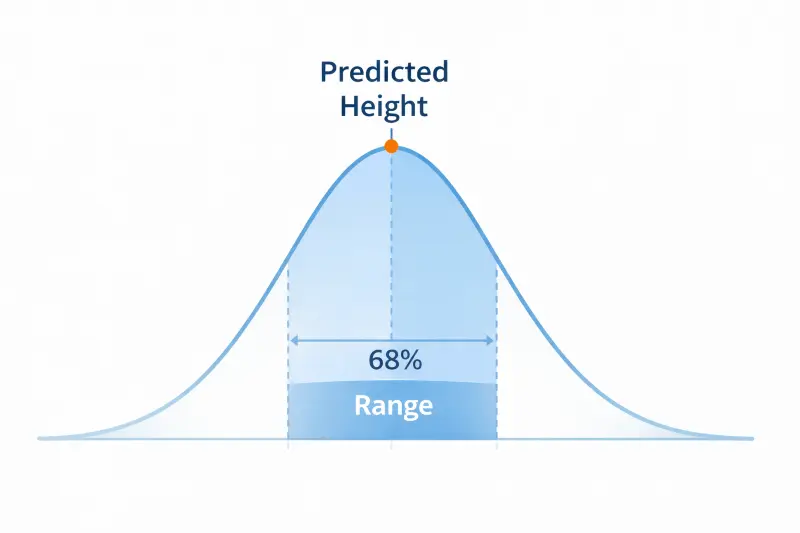
Height prediction distribution showing how 68% of children fall within ±2 inches of their genetic target height (One Standard Deviation).
Common Input Errors to Avoid
- Using Non-Biological Parents: The Tanner Method is a genetic calculation. Entering the height of adoptive parents or step-parents will result in a biologically invalid prediction.
- Ignoring the Range: A common mistake is treating the "Estimated Adult Height" as a guaranteed outcome. Users should view the "Most Likely Range" as the true target, rather than the single specific number.
Understanding Mid-Parental Height: The Science of Genetics
Every parent has asked the question at some point: "How tall will my child be?" While no crystal ball exists, pediatricians and endocrinologists use a well-established medical standard called the Mid-Parental Height method to find the answer.
Unlike simple "old wives' tales" (like doubling a child's height at age two), the mid-parental height method relies on the strongest predictor of a child's growth: biological genetics. For a more comprehensive prediction that combines parental genetics with your child's current growth data, you can also use our Height Calculator which uses the advanced Khamis-Roche method (read about the accuracy here).
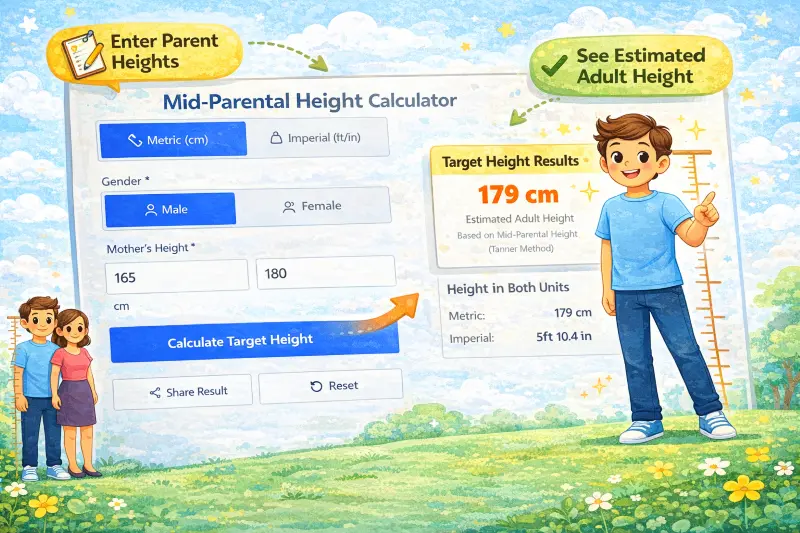
Our Mid-Parental Height Calculator interface - simply enter both parents' heights to predict your child's genetic target height.
What is "Mid-Parental Height"?
Think of Mid-Parental Height as your child's "Genetic Target." It is a calculation that takes the height of the biological mother and father to determine the statistical range where their child will most likely end up as an adult.
- It is a Range, Not a Point: Genetics rarely hit a single bullseye. Instead, most doctors look for a target range of ± 2 inches (or ± 5 cm) around the calculated result.
- It Checks for Health: Doctors often use this estimated mid parental height calculator to check for growth disorders. If a child's projected height is vastly different from their parents' genetic potential, it might signal a hormonal issue or nutritional deficiency.
The Formula: How We Calculate the Result
Our tool uses the "Tanner Method," the gold standard used by pediatric endocrinologists. While the math can be done two ways, the result is identical.
For Boys
For Girls
Note: This formula predicts the final target. To see how she should be growing right now, check our Girls Height Chart.
Understanding the "Target Range" (Standard Deviation)
Genetics is not an exact science, so doctors look at a "Prediction Range" rather than a single number.
- Most Likely (± 2 inches): 68% of children will end up within 2 inches (5 cm) of this calculated result (1 Standard Deviation).
- Possible (± 4 inches): 95% of children will fall within 4 inches (10 cm) of this result (2 Standard Deviations).
Why "Inches" and "Centimeters" Matter
Whether you are looking for a mid parental height calculator inches or a mid parental height calculator cm, the math remains the same principle. Our tool automatically handles the conversion.
- Inches: Common in the USA and older UK generations.
- Centimeters: The standard for medical charting in Australia, Canada, and modern UK healthcare.

The Tanner Method formula visually explained - showing how we calculate genetic target height for boys and girls.
Why the Result is an Estimate (Not a Promise)
One of the most common questions we see from parents is: "My child's predicted height is different from their current growth curve. Which one is right?"
It is important to remember that a mid-parental height calculator provides a statistical estimation, not a biological guarantee. While genetics determine about 80% of height, the remaining 20% is influenced by environment, nutrition, and random genetic shuffling.
The "Regression to the Mean" Phenomenon
You might notice an interesting pattern if you come from a very tall or very short family.
- Tall Parents: If both parents are exceptionally tall (e.g., Dad is 6'4", Mom is 5'11"), their children often end up slightly shorter than the mid-parental prediction.
- Short Parents: If both parents are below average height, their children often end up slightly taller than expected.
This is a statistical concept called "Regression to the Mean." Nature tends to pull extreme traits back toward the average over generations. So, if you are using a mid parental height calculator for boys and get a result that seems slightly conservative compared to your own height, this biological "correction" might be why.
The Sibling Mystery: Same Parents, Different Heights
A frequently asked question is: "If the formula is based on Mom and Dad, why is my brother 3 inches taller than me?"
The mid-parental height formula calculator gives the average target for your children. However, every child inherits a different "shuffle" of genes.
- The Genetic Lottery: You might inherit your grandfather's height genes, while your sibling inherits your grandmother's. This is why we often see a "range" of ±2 inches (5 cm).
- Grandparents Matter: As one Reddit user noted, "My parents are average, but I'm 6'4". Often, "tall genes" can skip a generation. If you have a tall grandparent, a child may exceed their estimated mid parental height.
When to Worry: The "Centile" Mismatch
Doctors use this tool primarily to check for health issues. They compare your child's current growth percentile against their target genetic percentile.
If your child is currently in the 10th percentile for height, but your mid parental height centile calculator result suggests they should be in the 75th percentile based on family history, this gap is significant. To check your child's current percentile, you can use our Height Percentile Calculator to see where they stand today compared to other children their age.
It doesn't mean something is wrong, but it is often the trigger for a pediatrician to check for things like:
- Nutrition: Is the child absorbing enough calories?
- Hormones: Is there a delay in growth hormone release?
- Puberty Timing: Is the child simply a "late bloomer" who will catch up later?
For comprehensive guidance on evaluating growth concerns, healthcare providers can reference the Evaluation of Short and Tall Stature in Children guidelines from the American Academy of Family Physicians.
Can You Be Taller Than Your Parents? (Maximizing Potential)
A common debate among parents, and one often seen on forums like Reddit, is whether a child is strictly bound by their parents' height.
The Short Answer: No. Genetics determine the "ceiling" (maximum potential), but environmental factors determine if you actually reach it.

Environmental factors and modern advantages that can help children exceed their parents' height through optimal nutrition and healthcare.
Historically, humans have been getting taller. This trend, known as the "secular trend," is largely due to better nutrition and health care compared to previous generations. If your parental mid height calculator result seems short, remember that your child has advantages you or your grandparents might not have had.
To ensure your child reaches the top end of their genetic prediction range, focus on these three pillars:
- Nutrition (The Building Blocks): Bones need calcium, Vitamin D, and protein to lengthen. A diet deficient in these during the critical growth windows (toddlerhood and puberty) can lead to a final height below the mid-parental prediction.
- Sleep (The Growth Engine): Growth Hormone (HGH) is released primarily during deep sleep. A chronic lack of sleep in teenagers can physically stunt growth, regardless of what the mid parental height formula calculator predicts.
- Health Status: Chronic illnesses (like severe asthma or celiac disease) can divert the body's energy away from growth. Treating these underlying conditions often leads to "catch-up growth."
Frequently Asked Questions
Is this calculator accurate for all countries (UK, Australia, USA)?
Yes. The mid parental height formula calculator is based on universal biological principles of inheritance, not specific national averages.
Mid Parental Height Calculator UK / Australia: Whether you are in London or Sydney, the genetics of height work the same way. Our tool automatically accepts inputs for a mid parental height calculator cm (metric) or feet/inches (imperial) to suit your region's standard. UK parents can also reference the official BOYS UK Growth chart 2-18 years and GIRLS UK 2-20 yr Childhood and puberty close monitoring (CPCM) growth chart for additional growth tracking.
What is the exact formula used for boys vs. girls?
We use the standard Tanner method correction for sexual dimorphism:
- Mid Parental Height Calculator for Boys: We take the average of the parents and add 2.5 inches (6.5 cm). This accounts for the fact that men are biologically taller on average.
- Mid Parental Height Calculator Girl: We take the average of the parents and subtract 2.5 inches (6.5 cm).
Note: This simple ±2.5 inch adjustment is why a brother and sister with the same parents will have different target heights.
Why is my child's projected height lower than I expected?
If the result from the estimated mid parental height calculator is lower than you hoped, check if you are accounting for the "Range." Most children fall within ±2 inches (5 cm) of the calculation.
Example: If the calculator predicts 5'9", the "normal" genetic range is actually 5'7" to 5'11". A child reaching 5'11" is still considered to be within their normal mid-parental expectations.
Also, remember that boys often grow later than girls due to different growth spurts.
Can a child be taller than both parents?
Yes, this is very common, especially if the parents grew up in environments with poorer nutrition or had medical issues that stunted their own growth. In these cases, the child often surpasses the mid parental height centile calculator prediction because they are finally expressing the family's true genetic potential without environmental restrictions.
Can my child grow taller than this result?
Yes, this is just an estimation. Environmental factors like nutrition and 'recessive genes' play a huge role. See why it is possible to grow taller than your parents.
Last Updated: January 1, 2026