Child Height & Weight Percentile Calculator
Instantly track your child's development using official CDC growth standards. Enter your child's age, gender, height, and weight to see exactly where they rank among peers of the same age.
Fill in your child's current information to see their height and weight percentiles.
What is the Child Height & Weight Percentile Calculator?
This tool assesses your child's developmental status by comparing their measurements against official CDC Growth Charts (for ages 2–20) and WHO Standards (for infants 0–2). It calculates an exact percentile ranking, indicating how a child's height and weight compare statistically to peers of the same age and gender to monitor healthy growth patterns.
How to Use the Child Height & Weight Percentile Calculator
This tool utilizes data from the CDC Growth Charts to compare a child's current body measurements against a national average of children of the exact same age and gender. It calculates a "Percentile Ranking," which is the standard medical method for tracking growth patterns.
Step-by-Step Instructions
1. Select Measurement System
Toggle the button at the top to choose between Metric (cm/kg) or Imperial (in/lbs). Ensure this matches the device used to measure the child.
2. Select Gender
Choose Male or Female. This selection is critical because growth charts and developmental curves differ biologically between boys and girls.
3. Input Precise Age
Enter the child's age in Years and Months (e.g., 5 Years, 2 Months). Unlike simple calculators that round to the nearest year, this tool requires month-level precision to locate the correct point on the growth chart.
4. Enter Measurements
- Current Height: Input the child's standing height.
- Current Weight: Input the child's weight.
5. Calculate
Click "Calculate Percentiles" to generate the report.
Interpreting the Percentile Results
The results section displays two primary metrics: the Height Percentile and the Weight Percentile.
- Understanding the Number: The percentile indicates the child's position relative to 100 other children of the same age and gender.
- Example: A result of "81st Percentile" for height indicates the child is taller than 81% of their peers and shorter than the remaining 19%.
- Example: A result of "50th Percentile" indicates the median (average) measurement.
- Visual Ranking: The tool provides a text summary (e.g., "Heavier than 43% of boys at this age") to clarify the statistical position.
Common Input Errors to Avoid
- Rounding Age: Do not round the age to the nearest whole year. A 5-year-old varies significantly in size from a 5-year-11-month-old. Omitting the months will result in an inaccurate percentile.
- Incorrect Gender Selection: Comparing a female child against the male growth chart (or vice versa) will produce invalid data, as the median height and weight standards differ by gender.
Understanding Your Results: What Does the Percentile Mean?
When you use our height percentile calculator, the result gives you a specific number (e.g., "85th Percentile"). But what does this actually tell you about your child's health?
A percentile is a statistical ranking that compares your child to other children of the same age and gender. It answers the common parent question: "What height percentile is my child compared to the national average?"
- 50th Percentile: This is the statistical median. If your child is here, they are exactly the average height for their age group.
- Higher Percentiles (e.g., 75th, 90th): Your child is taller than average. For example, a result of "90th Percentile" means your child is taller than 90 out of 100 children of the same age.
- Lower Percentiles (e.g., 10th, 25th): Your child is shorter than average. Being in the 10th percentile simply means 90% of children are taller, while 10% are shorter.
- Future Prediction: Remember, a percentile is a snapshot of today. If you want to use this data to estimate their final adult height, try our Child Height Calculator. You can learn more about the science behind our calculator and why we use the Khamis-Roche formula for precision.
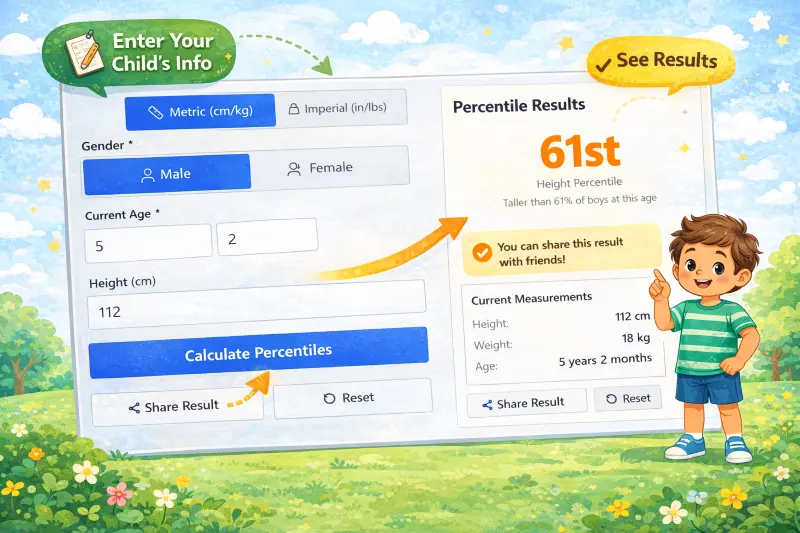
Our Height Percentile Calculator interface - enter your child's age, gender, height, and weight to see where they rank among peers.
The Science Behind the Data: CDC vs. WHO Standards
To ensure medical accuracy, our child height percentile calculator automatically switches between two different "Gold Standard" datasets based on your child's age. This methodology is identical to the one used by pediatricians during wellness visits.
1. Infants and Toddlers (0–24 Months)
For a baby height percentile calculator (ages 0 to 2), we utilize the WHO (World Health Organization) growth standards.
Why WHO? The WHO standards describe how healthy infants should grow under optimal conditions (mostly breastfed). This is the standard recommended by the CDC for American infants under age 2.
Keywords Covered: This covers specific searches like height percentile calculator baby, height percentile calculator girl 0-2, and who length percentile calculator.
2. Children and Teens (Ages 2–20)
For the height and weight percentile calculator for kids (ages 2 and up), we switch to the CDC (Centers for Disease Control and Prevention) clinical growth charts.
Why CDC? The CDC height percentile calculator data reflects how children typically grow in the United States across different demographics. It provides a realistic baseline for children as they enter school age and puberty.
Keywords Covered: This is essential for keywords like boys height percentile calculator, girls height percentile calculator, and pediatric height percentile calculator.
Is My Child's Growth "Normal"?
A common misconception is that a child must be in the 50th percentile to be healthy. In reality, "normal" is a wide range.
According to pediatric guidelines, any growth curve between the 5th and 95th percentiles is generally considered healthy, provided the child follows their own curve consistently.
- Steady Growth is Key: The most important factor isn't a single number from a height percentile calculator, but the trajectory. If your child consistently tracks along the 15th percentile from age 2 to age 10, that is their healthy normal.
- Red Flags: A sudden drop (e.g., falling from the 75th down to the 25th percentile) may warrant a discussion with a pediatrician about nutrition or hormonal health.
Getting Accurate Data: Measuring Infants vs. Children
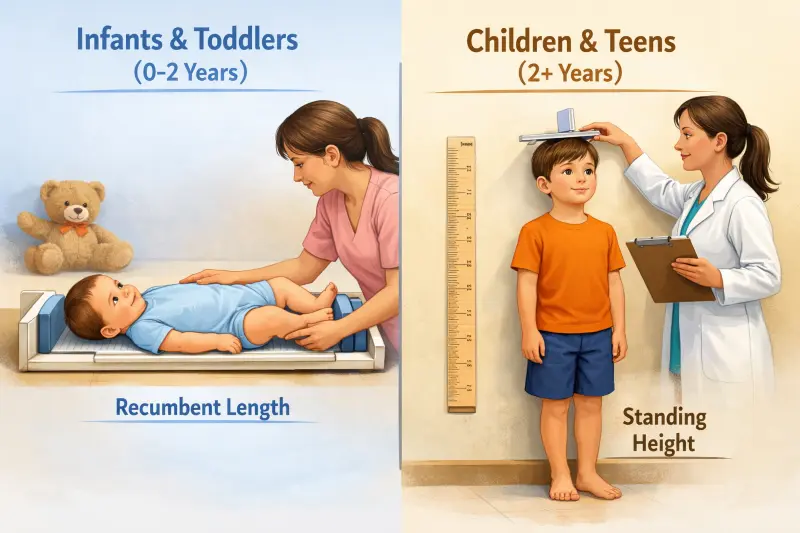
Proper measurement techniques: Recumbent length for infants (0-24 months) vs. standing height for children (2+ years).
To get a precise result from our child height and weight percentile calculator, the way you measure your child is critical. The CDC and WHO protocols change depending on the child's age, and using the wrong method can skew the percentile by several points.
1. Infants and Toddlers (0–2 Years): Recumbent Length
For the infant height percentile calculator (ages 0-24 months), medical standards require measuring "Recumbent Length" that is, measuring the baby while they are lying down flat.
Why it matters: Babies cannot stand straight enough to fight gravity compression. A standing measurement for a toddler will often be inaccurate.
How to do it: Place the child on a firm surface. Mark the top of the head and the bottom of the heel while the leg is fully extended.
Keywords: This method is essential when using a baby weight and height percentile calculator or a toddler height percentile calculator to ensure the data aligns with WHO standards.
2. Children and Teens (2+ Years): Standing Stature
Once a child turns two, pediatricians switch to "Standing Height" (Stature). Our height and weight percentile calculator by age automatically adjusts for this switch.
The Gravity Factor: Interestingly, a child is slightly shorter when standing up due to spinal compression caused by gravity.
Best Practice: Have the child stand against a wall without shoes, heels touching the baseboard, looking straight ahead (Frankfurt Plane).
Watch: Proper Height Measurement Technique
See video demonstration of correct measuring methods →Boys vs. Girls: Why We Use Separate Percentile Charts
You might notice that we have specific options for a height percentile calculator boy and a height percentile calculator girl. This is not just a preference; it is a biological necessity.
Human growth patterns exhibit significant sexual dimorphism (biological differences between sexes) that becomes more pronounced with age.

Understanding percentiles: Visual explanation of how height percentiles work differently for boys and girls during growth.
The Growth Curve for Girls
When tracking the average height for girls by age, you will notice the curve accelerates earlier.
- Early Bloomers: Girls typically enter puberty earlier (ages 10–12). A 10-year-old girl in the 50th percentile is often taller than a 10-year-old boy in the same percentile.
- Plateau: As explained in our girls height growth guide, because their growth plates fuse earlier, the curve flattens out sooner, usually by age 15.
- Target: This is vital for parents searching for a height and weight percentile calculator girl to understand that an early slowing of growth is often normal.
The Growth Curve for Boys
The boys height percentile calculator follows a different trajectory.
- Steady Growth: Boys tend to have a longer period of pre-pubertal growth.
- Late Peak: The peak growth spurt for a male height percentile calculator dataset typically occurs around age 13–15.
- Final Height: Because boys have two additional years of childhood growth before their spurt, the 50th percentile for adult men ends up being significantly higher (approx. 5ft 9in) than for women. (Curious about your son's specific potential? Use our height predictor to see his estimated adult stature).
Weight Considerations (Height-for-Weight)
Many parents use this tool as a height and weight percentile calculator. While height tracks linear growth, weight tracks nutritional status.
- BMI for Age: For children over 2, the CDC recommends tracking "Body Mass Index for Age" rather than just raw weight.
- Infants: For a baby height and weight percentile calculator, weight-for-length is the primary metric doctors use to screen for failure to thrive or rapid weight gain.
Global Standards & Adult Height Percentiles
While our primary tool is a child height percentile calculator, many users want to know how their final adult height ranks against the general population. It is important to note that adult percentiles work differently than child growth charts.
- Children (Growth): Used to track health and development. A changing percentile can indicate a medical issue.
- Adults (Demographics): Used for statistical comparison. Your percentile as an adult is static.
Adult Height Percentiles (USA)
In the United States, adult height data is collected by the National Health and Nutrition Examination Survey (NHANES). If you are looking for an adult height percentile calculator or a us height percentile calculator, here are the benchmarks for the standard American population (Ages 20+):
- Average (50th Percentile): The median man is roughly 5'9" (175 cm), and the median woman is 5'4" (163 cm).
- Tall (90th Percentile): A man at 6'0" (183 cm) is taller than 90% of the male population.
- Very Tall (99th Percentile):
- 6'3 height percentile: A man standing 6'3" (190 cm) is in the 99th percentile. He is taller than 99 out of 100 random men in the USA.
- 6'2 percentile height: A man at 6'2" (188 cm) sits comfortably in the 97th percentile.
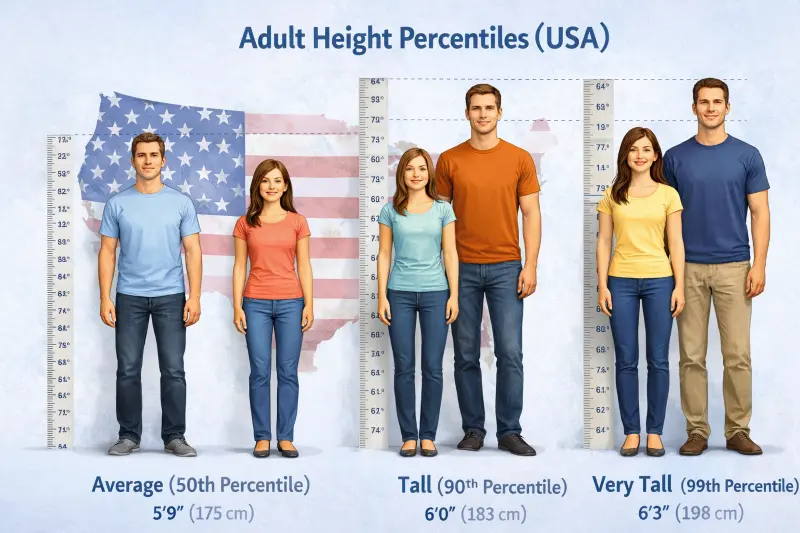
Adult height distribution in the USA: Statistical breakdown showing height percentiles for American men and women aged 20+.
International Differences: Height by Country
"Normal" is relative. A height percentile calculator by country yields very different results depending on geography. Genetics and environmental factors (like childhood nutrition) create vast differences in national averages.
- Height Percentile Calculator India: In India, the average height is lower than in the West. A man who is 5'9" (175 cm) might be in the 50th percentile in the USA, but could be in the 85th or 90th percentile in India.
- The Netherlands: The Dutch are the tallest nation on Earth. A man who is 6'0" (183 cm) is merely "average" (50th percentile) in the Netherlands, whereas he would be "tall" in the USA.
Real-World Example: Tracking a Toddler
To understand how to read these charts for kids, let's look at a specific search query we often see: "3 year old 38 inches tall percentile."
If you enter this data into our toddler height percentile calculator:
- Age: 36 Months (3 Years)
- Height: 38 Inches (approx. 96.5 cm)
- Result: This child falls roughly into the 50th Percentile (CDC Boys).
Interpretation: This is the classic definition of "Average." He is growing exactly right down the middle of the growth curve.
Action: No action needed. This indicates healthy, steady growth.
Fun Facts: Height Extremes & World Records
Curious about the limits of human growth? Here are the official Guinness World Records.
- Tallest Man in History: Robert Wadlow (USA) reached an incredible 8 ft 11 in (272 cm) before his death in 1940.
- Tallest Living Man: Sultan Kösen (Turkey) stands at 8 ft 2.8 in (251 cm).
- Shortest Adult Human: Chandra Bahadur Dangi (Nepal) measured just 21.5 inches (54.6 cm).
- Tallest Nation: The Netherlands currently has the tallest average population, with men averaging nearly 6 ft 0 in (183 cm).
Frequently Asked Questions
What is the "WHO Growth Chart Percentile Calculator"?
The WHO (World Health Organization) charts are the international standard for infants (0-24 months). Unlike older charts, the WHO standards are based on breastfed babies raised in optimal health conditions. Our baby height percentile calculator automatically uses this "Gold Standard" dataset for any child under age 2 to ensure medical accuracy.
Download Official WHO Growth Standards:
- WHO Child Growth Standards (2009) - Complete growth charts and methodology
- WHO Growth Standards (2007) - Head circumference and motor development
- WHO Growth Standards (2006) - Length/height and weight charts
Is there a height percentile calculator for specific countries (India, UK, Canada)?
Most medical tools rely on two major datasets: WHO (Global) and CDC (USA).
- 0-5 Years: The WHO standards are considered applicable worldwide, making them accurate for parents in India, the UK, or Canada.
- 5-19 Years: While our tool defaults to CDC height percentile calculator data (which is diverse), local averages may vary slightly. However, the trend of your child's growth is more important than the exact national ranking.
Why do I get different results for boys and girls?
You will see different rankings because we use specific height percentile calculator boy and height percentile calculator girl datasets. Biologically, girls often grow faster than boys between ages 10 and 12 due to earlier puberty, while boys grow for a longer period. Using a gender-neutral chart would give inaccurate medical data.
Can I use this as an adult height percentile calculator?
This specific tool is designed as a pediatric height percentile calculator (ages 0-20). Adult percentiles work differently because adults stop growing.
- For Kids: Percentiles track growth velocity (health).
- For Adults: Percentiles track demographics (comparison).
Reference: A man who is 5'9" (175 cm) is in the roughly 50th percentile for US adults.
Does this tool calculate weight percentiles?
Yes. This is a dual-function height and weight percentile calculator.
- For Babies (0-2): Doctors monitor "Weight-for-Length" to ensure the baby is gaining mass in proportion to their growth.
- For Kids (2-20): We recommend looking at BMI-for-Age for accurate health assessment.
My child is in the 10th percentile. Is that bad?
Not necessarily. Being in a lower percentile on a child height percentile calculator does not mean your child is unhealthy.
- The Rule: Anything between the 5th and 95th percentile is considered a normal variation of healthy growth.
- The Key: Watch for consistency. If your child has always been in the 10th percentile, that is likely their genetic pattern. You should only be concerned if they drop suddenly (e.g., from the 50th down to the 10th).
Last Updated: January 1, 2026