What is the Khamis-Roche Method?
Definition and Origin
The Khamis-Roche method is a medical algorithm designed to predict a child's adult stature. It was developed by Dr. Harry Khamis and Dr. Alex Roche and published in the journal Pediatrics in 1994.
Table of Contents
The Data Source: Fels Longitudinal Study
The formula was derived from the Fels Longitudinal Study, one of the longest-running studies of human growth in history. Researchers tracked thousands of children from birth to adulthood, measuring their bone age, height, and weight at every interval. This massive dataset allowed them to create an equation that predicts future outcomes based on current measurements.
How the Formula Works (The Science)
The Three Critical Inputs
Most simple calculators only look at genetics. The Khamis-Roche method improves accuracy by combining three distinct factors:
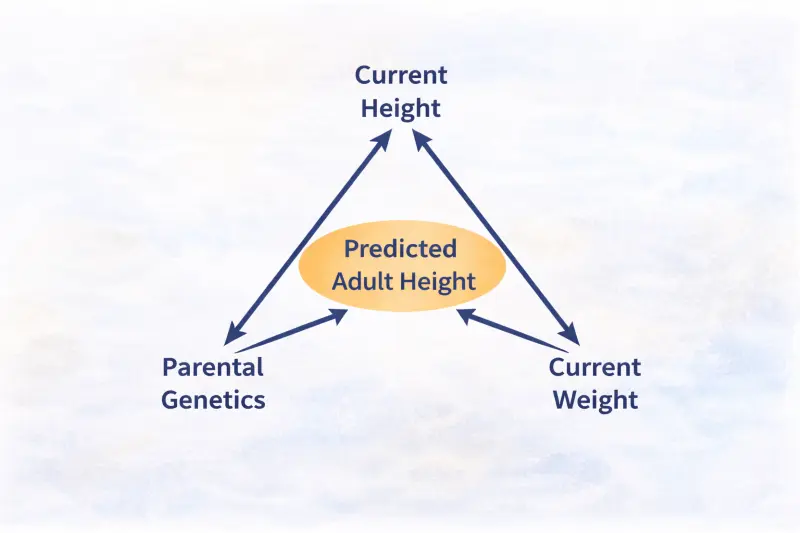
Scientific diagram showing how the Khamis-Roche method combines multiple factors for accurate height prediction.
- Current Height: Indicates the child's present growth status.
- Mid-Parental Height: Establishes the genetic potential (the "ceiling" and "floor" of their height).
- Current Weight: This is the unique differentiator.
Why Does the Calculator Need Weight?
Many parents ask: "Why does weight matter for height?"

Visual comparison showing how different body weights can indicate varying skeletal maturity levels in children of the same age.
- Bone Age Estimation: Weight is a strong biological indicator of skeletal maturity.
- Early vs. Late Bloomers: Heavier children often have advanced bone age (growing faster now, stopping sooner). Lighter children often have delayed bone age (growing slower now, but growing for longer).
- The Adjustment: The formula uses weight to adjust the prediction, ensuring it doesn't overestimate the height of an early bloomer or underestimate a late bloomer.
Accuracy Comparison: Khamis-Roche vs. Other Methods
Parents often wonder which method they can trust. The table below compares the four most common prediction techniques.

Visual comparison of height prediction method accuracy showing Khamis-Roche as the most accurate non-invasive option.
| Method | How it Works | Requires X-Ray? | Margin of Error | Accuracy Level |
|---|---|---|---|---|
| Double Height at Age 2 | Multiplies height at 24 months by 2. | No | ± 4.0 inches | Low (Rough Estimate) |
| Mid-Parental (Tanner) | Averages parents' height ± 2.5 inches. | No | ± 3.5 inches | Medium (Genetic Only) |
| Khamis-Roche | Uses Height + Weight + Parents. | No | ± 1.5 inches | High (Best Non-Invasive) |
| Greulich-Pyle (Bone Age) | Analyzes growth plates in hand/wrist. | Yes | ± 1.0 inch | Very High (Medical Standard) |
The "Double Height at Age 2" Myth
Is Doubling Height at 2 Accurate?
A common "old wives' tale" suggests that a child is exactly half their adult height at age 2.
- For Boys: This is sometimes roughly accurate, as boys grow for a longer period.
- For Girls: This is often inaccurate. Girls typically reach half their adult height closer to 18 months (1.5 years) because they stop growing sooner than boys.
Why It Fails
The "Double Height" rule ignores puberty timing. It cannot tell if a 2-year-old is tall because they are genetically tall, or simply because they are growing fast early. The Khamis-Roche method corrects this error by factoring in the parents' height and the child's weight.
Step-by-Step: The Prediction Logic
The Weighted Equation
The actual math involves specific multipliers (beta coefficients) that change every 6 months of a child's life. The simplified logic is:
- The Intercept: The formula starts with a baseline number based on the child's gender and exact age (e.g., 8 years and 6 months).
- Height Multiplier: It adds points for every inch of current height.
- Weight Multiplier: It adjusts the score based on body mass (BMI proxy).
- Parental Multiplier: It pulls the final result toward the average of the parents.
Note: Because these multipliers change constantly, it is not practical to calculate this manually. Using an automated Khamis-Roche calculator is necessary for precision.
Limitations: When is the Method Less Accurate?
1. Ethnicity and Demographics
The original Fels Longitudinal Study primarily tracked Caucasian children in the United States. While the biological principles of growth are universal, the formula may have a slightly higher margin of error for:
- Asian Populations: May overestimate height if puberty occurs earlier.
- Hispanic/Latino Populations: May vary based on nutritional differences.
2. Unusual Growth Patterns
The method assumes the child is healthy and following a standard growth curve. It may not be accurate for:
- Precocious Puberty: Children starting puberty before age 8 or 9.
- Growth Hormone Deficiency: Children treating medical short stature.
- Competitive Athletes: Gymnasts or wrestlers who may have delayed puberty due to intense training.
Frequently Asked Questions
Is there a 100 percent accurate height predictor?
No. No calculator, including medical X-rays, can predict height with 100% certainty. Environmental factors like nutrition, sleep quality, and chronic illness during teenage years can alter the final outcome. The Khamis-Roche method is the statistically closest estimate available without radiation.
Can I use this for a 2-year-old?
Yes, but it is better after age 4. While the formula supports ages as young as 4, predicting height at age 2 is volatile. Toddlers often shift percentiles ("catch-up" or "catch-down" growth) between ages 2 and 3. For a 2-year-old, the "Double Height" rule is often used just for fun, but Khamis-Roche becomes the superior scientific choice once the child enters school.
How do I calculate this if I don't know the father's height?
You cannot use the Khamis-Roche method. This specific formula relies heavily on the "Mid-Parental" variable. If one biological parent is unknown (e.g., adoption or donor), you must rely on a standard growth chart percentile projection instead, which assumes the child will stay on their current curve.
Is the Khamis-Roche method accurate for "Late Bloomers"?
Yes, because it uses weight. Late bloomers are often lighter and thinner for their age. The formula recognizes this lower weight and calculates a "delayed" skeletal age, effectively predicting that the child has more years of growth left than their peers.
Does this calculator work for Asian or Indian children?
It is widely used globally but with caveats. While the baseline data is American, pediatricians worldwide use it as a reference. However, in populations where puberty starts earlier (often seen in some South Asian demographics), the calculator might slightly overestimate the final height.
Why is my predicted height lower than my current percentile?
Regression to the Mean. If you are very tall but your parents are short, the formula will pull your prediction down. This is a biological concept called "Regression to the Mean," where nature tries to correct extreme heights back toward the family average over generations.
Is bone age X-ray more accurate than Khamis-Roche?
Only slightly. A bone age X-ray (Greulich-Pyle method) is the medical gold standard and reduces the margin of error to about 1 inch. However, it requires radiation and a doctor's visit. For home monitoring, Khamis-Roche is nearly as effective (within 1.5 inches) without the cost or radiation exposure.
My daughter started her period at 10. Will this affect the result?
Yes. The Khamis-Roche method calculates based on average puberty timing. If a girl starts her period very early (age 10), her growth plates will fuse sooner than average. In this specific case, the calculator might slightly overestimate her final height.
How tall will I be if my mom is 5'3" and my dad is 5'10"?
The calculator needs your stats to answer this. Using only parents' height gives a generic range (approx. 5'7" for a boy, 5'2" for a girl). To get a precise answer, you must input your current age, height, and weight into the calculator so it can apply the Khamis-Roche multipliers.
Does lifting weights affect this prediction?
No. Contrary to popular myths, lifting weights does not stunt growth or alter your predicted height. However, extreme calorie restriction (often associated with sports like wrestling) can stunt growth, which would make the prediction inaccurate.
Medical Disclaimer
This content is for informational purposes only. The Khamis-Roche method provides a statistical estimate based on historical growth data. It does not guarantee a specific biological outcome. If you have concerns about a child's growth velocity or signs of delayed puberty, please consult a pediatric endocrinologist for a formal evaluation.