How to Measure Height Accurately
Precision depends entirely on the child's age and the measurement surface. The technique changes significantly between infants and older children due to developmental differences in posture and cooperation.
Infants (0–2 Years)
Measure recumbent length lying down. You must straighten the legs fully to get an accurate input for growth charts.
Children (2+ Years)
Measure stature standing up. The child stands barefoot against a vertical wall. The head is aligned so the eyes look straight ahead.
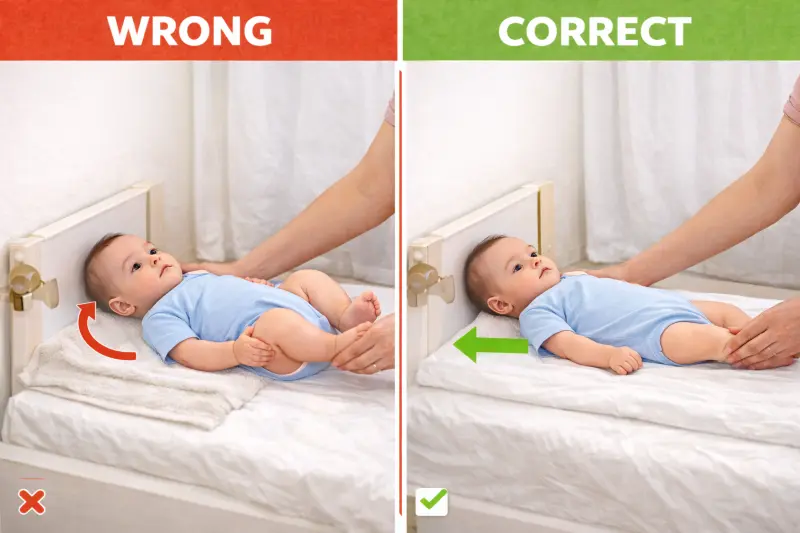
Demonstration of correct infant and child measurement techniques for accurate height data collection.
Key Tool
Use a rigid book or box to form a 90-degree angle with the wall. Flexible tape measures alone cause "parallax error" (viewing angle mistakes).
Data Entry: Accurate inputs are essential when using a Child Height Calculator to predict future growth milestones.
Ready to track your child's growth?
Once you have accurate measurements, use our calculators to track percentiles and predict future height based on current growth patterns.
Calculate Height PercentileCommon Home Measurement Issues & Solutions
Table of Contents
This section identifies specific obstacles parents face at home and how to fix them to ensure calculator accuracy.
Issue 1: The "Carpet Effect"
Problem:
The child appears shorter than they are.
Why:
Plush carpets or rugs compress under weight, causing the heels to sink 0.5 cm to 2 cm.
Solution:
Always measure on a hardwood, tile, or concrete floor. If only carpet is available, place a hardcover book under the child's feet and measure from the top of the book.
Issue 2: Baseboard Interference
Problem:
The child enters a "slouching" posture.
Why:
Thick baseboards prevent the heels from touching the wall. This forces the body forward and curves the spine.
Solution:
Have the child stand with heels slightly forward (touching the baseboard) but ensure the buttocks, shoulders, and head still touch the wall firmly.
Issue 3: The "Squirming Infant" (0–2 Years)
Problem:
The measurement is shorter than reality.
Why:
Babies naturally flex their knees and hips. A bent leg reduces the measured length significantly.
Solution:
Use two people. Person A holds the head against the headboard. Person B places a hand gently on the knees to extend the legs fully before marking the heel position.
Issue 4: "Morning vs. Evening" Variance
Problem:
Height differs when measured at different times.
Why:
Gravity compresses the spine and cartilage discs throughout the day. A child is tallest in the morning and shortest before bed.
Solution:
For consistent tracking, always measure at the same time (e.g., right after waking up).
Case Study: The Impact of Measurement Errors

Proper measurement technique is essential for accurate growth tracking and calculator inputs.
Small errors in technique can drastically alter the interpretation of a child's health data. The following scenario illustrates how a simple error, such as wearing sneakers, changes the output of a growth calculator.
Scenario: A parent measures their 5-year-old son to check his growth progress.
| Measurement Condition | Recorded Height | Percentile Result (WHO/CDC) | Interpretation |
|---|---|---|---|
| A. With Sneakers (Incorrect) | 112 cm | 75th Percentile | Child appears "Tall" |
| B. Barefoot (Correct) | 109 cm | 50th Percentile | Child is "Average" |
Analysis:
The Error:
Including the 3 cm sole of the shoe artificially inflated the child's height.
The Consequence:
This shifted the child by 25 percentile points. If this incorrect data is used in a Percentile Calculator or Mid-Parental Calculator, it creates a false baseline, making it difficult to track actual growth velocity or spot potential health issues later.
Standardized Protocols (WHO & CDC)
Global health standards define specific physical criteria to ensuring data validity. The World Health Organization (WHO) protocols establish the international framework for accurate child measurements. Understanding the differences between WHO and CDC standards helps ensure you're using the correct measurement approach for your child's age.
The Frankfort Plane
An imaginary line from the ear hole to the bottom of the eye socket must be parallel to the floor. This follows standardized anthropometric procedures used in clinical settings.
Hair Check
Measuring over thick hair, buns, or braids adds false height. You must compress the hair or undo the style to reach the skull.
Clothing
Heavy clothes hide posture defects. Protocols require light clothing and bare feet.
Community Data on Equipment
Parents often struggle with "portability" when tracking growth over decades.
Wall Marking:
The most common method, but data is lost during moves or painting.
The "Giant Ruler" Solution:
Community consensus favors 1x6 inch wooden boards. These can be removed and transported.
Door Slabs:
Families living in rentals often mark the side of a door slab (not the frame) so they can take the door with them when moving.
Comparison of Measurement Tools
The table below contrasts the equipment and precision levels.
| Feature | Recumbent Length (0–2 Years) | Standing Stature (2+ Years) |
|---|---|---|
| Position | Lying down (Supine) | Standing upright |
| Required Staff | Two people (Head holder + Leg straightener) | One person |
| Equipment | Firm flat surface + Headboard | Wall + Rigid Book/Box |
| Key Error | Flexed knees (underestimates length) | Slouching (underestimates height) |
| Variation | Typically 0.7 cm longer than standing | Compresses during the day |
Step-by-Step Measurement Process
Process for Infants (0–2 Years)
Setup:
Place a paper sheet on a firm floor or table (not a soft mattress).
Head:
Person A holds the baby's head so the crown touches a fixed vertical surface (wall/headboard). Eyes look straight up.
Legs:
Person B places a hand on the knees to gently press them flat.
Feet:
Person B places a book upright against the soles of the feet and marks the paper.
Measure:
Use a steel tape to measure the distance from the wall to the mark.
Process for Children (2+ Years)
Stance:
Remove shoes. Stand on a hard floor.
Align:
Heels, buttocks, shoulders, and head touch the wall.
Head Position:
Ensure eyes look straight ahead (Frankfort Plane).
Square It:
Lower a book/box until it touches the crown of the head. It must form a perfect right angle with the wall.
Record:
Mark the wall lightly and measure from the floor to the mark.
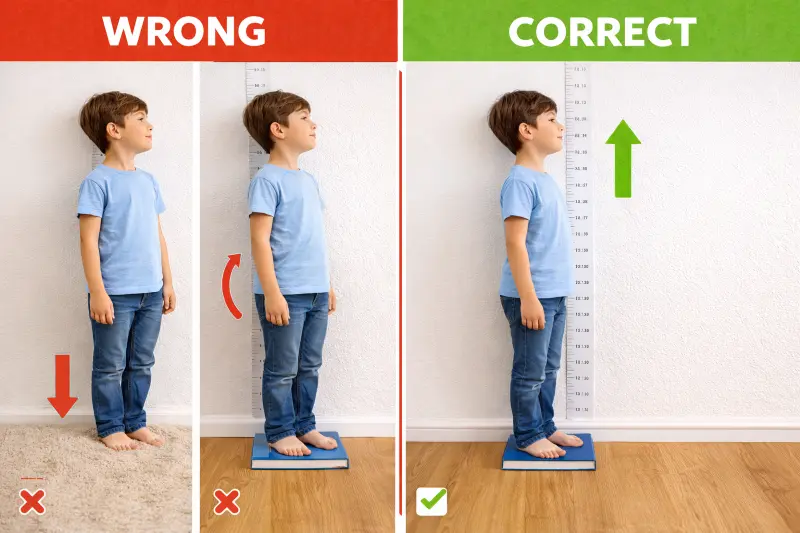
Correct measurement positioning ensures accurate data for growth chart interpretation.
How to Read a Growth Chart
Once you have the measurement, interpreting the chart correctly is critical for understanding your child's development. The CDC growth charts provide the standard reference for tracking growth patterns in the United States.
Understanding the Grid
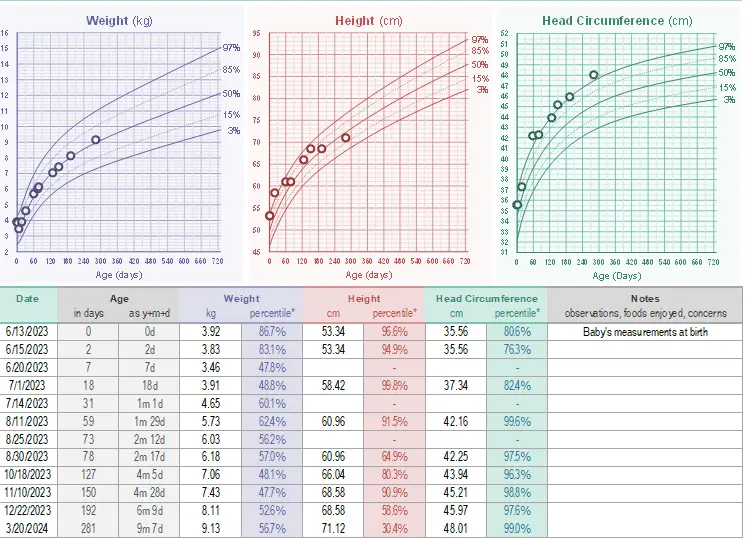
Visual guide showing how to interpret growth chart axes, percentile lines, and data points.
Horizontal Axis (X):
Represents the child's age (in months or years).
Vertical Axis (Y):
Represents the child's height (in cm or inches).
Curved Lines:
These represent the Percentiles (5th, 10th, 25th, 50th, 75th, 90th, 95th).
Plotting the Point
Interpreting the Percentile
50th Percentile:
This is the median. The child is taller than 50% of children their age.
75th Percentile:
The child is taller than 75% of their peers.
Beyond Height Tracking:
Accurate height measurements are also essential for calculating BMI-for-age percentiles. Learn why child BMI differs from adult BMI and requires precise height data for proper interpretation.
Input Verification:
To ensure you have read the chart correctly, you can input your data into our automated Percentile Calculator for instant verification.
Inches vs. Centimeters
Avoiding Conversion Errors
Most medical and scientific tools use the metric system (centimeters), while many US households use imperial (feet/inches).
The Golden Rule:
1 Inch = 2.54 Centimeters
Rounding Risk:
Rounding "5 feet 4.3 inches" to just "5 feet 4 inches" creates a significant data gap.
Recommendation:
If possible, measure directly in centimeters. If measuring in inches, keep the decimal point (e.g., 42.5 inches) before converting to ensure accuracy in the Mid-Parental Calculator.
FAQ
Do doctors measure height with shoes?
Standard protocol requires bare feet. If a doctor measures with shoes, the data is technically inaccurate. This extra height can shift a child's percentile on growth charts.
Is it true that 2-year-olds are half their adult height?
This is a rough estimation. It is not a strict biological rule. Puberty timing and genetics play a major role. For a more accurate prediction based on family genetics, use our Mid-Parental Calculator. For comprehensive guidance on pediatric growth monitoring, consult with your healthcare provider.
Can I measure my height with my phone?
Phone apps are not clinical grade. AR (Augmented Reality) apps provide estimates but lack the millimeter precision needed for medical history.
How do I measure a squirming baby?
You need two people. If the legs are not fully straight due to kicking, the measurement will be short. Wait for a calm moment or use the two-person hold technique described above.
Why is my child shorter in the evening?
Spinal compression. Gravity compresses the fluid in the spine's discs during the day. This is normal. Measure in the morning for the "tallest" accurate result.
Disclaimer
This content is provided for informational purposes only and does not constitute medical advice or diagnosis. The methods described here are for home estimation and data entry into online calculators. Always consult a pediatrician or healthcare provider for professional growth monitoring and medical assessment.