What is Mid-Parental Height?
Mid-Parental Height (MPH), often referred to as the genetic potential height, is a calculation used by pediatricians and endocrinologists. It provides a baseline expectation for a child's adult height assuming they grow according to their genetic lineage.
Doctors use this figure to determine if a child's current growth curve is appropriate. If a child plots significantly below their mid-parental height centile, it may indicate familial short stature or constitutional growth delay (late bloomers). Conversely, plotting significantly above may indicate rapid maturation.
Table of Contents
The Formula: Calculating Target Height

The Tanner Method formula used for calculating mid-parental height and genetic potential.
The standard calculation used globally is known as the Tanner Method or Tanner Height Prediction. It adjusts the average height of the parents to account for sexual dimorphism (the biological height difference between males and females).
Mid-Parental Height Formula for Boys
To calculate the genetic target for a male child:
Imperial (Inches):
- 1. (Mother's Height + Father's Height) ÷ 2 = Average Parental Height
- 2. Average Parental Height + 2.5 inches = Mid-Parental Height
Alternative Calculation: (Mother's Height + 5 inches + Father's Height) ÷ 2.
Metric (Centimeters):
(Mother's Height + Father's Height + 13 cm) ÷ 2 = Mid-Parental Height
Mid-Parental Height Formula for Girls
To calculate the genetic target for a female child:
Imperial (Inches):
- 1. (Mother's Height + Father's Height) ÷ 2 = Average Parental Height
- 2. Average Parental Height - 2.5 inches = Mid-Parental Height
Alternative Calculation: (Father's Height - 5 inches + Mother's Height) ÷ 2.
Metric (Centimeters):
(Mother's Height + Father's Height - 13 cm) ÷ 2 = Mid-Parental Height
Understanding the "Target Range" (Accuracy)
A common misconception is that the formula predicts an exact height. In clinical practice, the MPH represents the center of a Target Height Range.
Standard Deviation
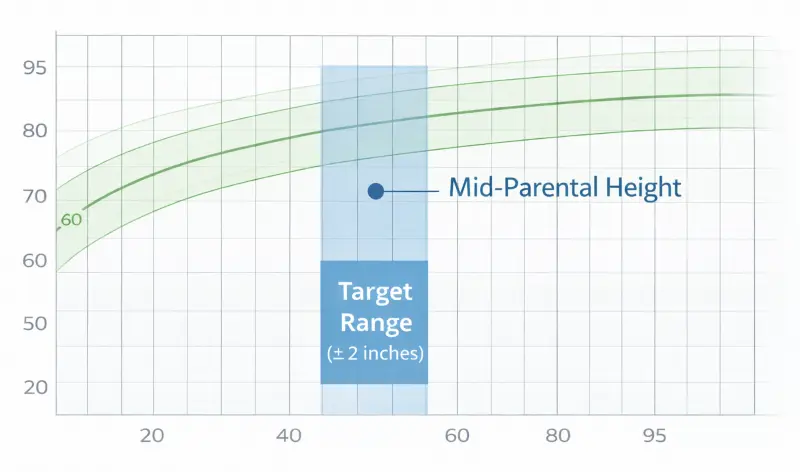
Growth chart illustration showing the target range with standard deviation around mid-parental height.
Genetics is not the only factor in growth. Nutrition, sleep, and overall health also play critical roles. Therefore, the Target Height is defined as the Mid-Parental Height ± 2 standard deviations.
- Inches: MPH ± 2 to 4 inches.
- Centimeters: MPH ± 5 to 10 cm.
For example, if a boy's calculated MPH is 5'10" (178 cm), his expected genetic range is typically between 5'8" and 6'0".
Regression to the Mean
This statistical concept explains why very tall parents often have children slightly shorter than themselves, and very short parents often have children slightly taller. The genetics tend to pull the child's height closer to the population average over generations.
Mid-Parental vs. Tanner vs. Khamis-Roche
There are multiple methods to predict height. Understanding the difference helps manage expectations.
| Method | Data Required | Best Used For | Accuracy Level |
|---|---|---|---|
| Mid-Parental (Tanner) | Biological Parents' Height | Newborns to Toddlers | General Baseline (Genetic Potential) |
| Double Height at 2 | Child's Height at Age 2 | Quick estimation | Low (Rough Estimate) |
| Khamis-Roche | Parents' Height + Child's Weight/Height | Children age 4 to 17 | High (Calculates current trajectory) |
| Bone Age (X-Ray) | Wrist X-Ray | Medical diagnosis | Highest (Clinical Standard) |
Bone Age and Growth Anomalies
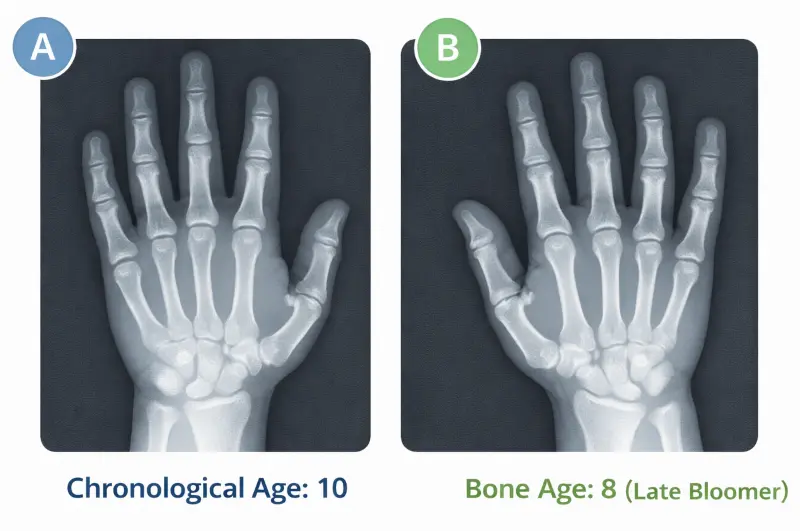
Comparison showing the difference between bone age and chronological age in growth assessment.
The Mid-Parental Height calculator assumes the child has a bone age that matches their chronological age. However, discrepancies occur.
Constitutional Growth Delay
This describes "late bloomers." These children often plot below their mid-parental height centile during childhood but continue growing after their peers stop, eventually reaching their genetic target. Learn more about Constitutional Growth Delay from the American Academy of Pediatrics.
Familial Short Stature
This describes children who are short because their parents are short. Their bone age typically matches their chronological age, and they will likely finish growing at a height consistent with the MPH formula.
Real-World Scenarios
User reports and reddit discussions highlight how these predictions play out in reality.
Scenario A: Surpassing the Prediction
Many users report exceeding their mid-parental prediction. Read our deep dive on can a child be taller than both parents to understand the genetics behind these exceptions. This often occurs when the parents grew up with poor nutrition or environmental stressors that stunted their growth. The child, raised in a better environment, reaches their full genetic potential, which the parents could not.
Scenario B: The "Tall" Toddler
Parents often ask if a tall 2-year-old will remain tall. While the "Double Height" rule suggests they will, the Mid-Parental formula might predict a shorter stature. In these cases, the child often undergoes "catch-down" growth, slowing their velocity to align with their genetic curve.
Frequently Asked Questions
What is the difference between target height and mid-parental height?
They are effectively the same metric. Mid-Parental Height is the specific calculation used to find the center number. Target Height usually refers to the MPH plus the acceptable range (standard deviation) surrounding it.
How tall will I be if my mom is 5'3" and my dad is 5'10"?
Approximately 5'9" for a boy or 5'4" for a girl.
- • Boy: (63 inches + 70 inches + 5) ÷ 2 = 69 inches (5'9").
- • Girl: (63 inches + 70 inches - 5) ÷ 2 = 64 inches (5'4").
Note: This includes a margin of error of roughly ±2 inches.
Can I calculate this if I don't know one parent's height?
No, the Tanner method requires both. If you do not know the biological father or mother's height (e.g., adoption or donor), you cannot use this formula. Instead, you should rely on a current percentile projection, which assumes the child will maintain their current growth curve.
Can a short baby become a tall adult?
Yes. Infant size (birth to 2 years) is largely determined by nutrition and the mother's womb environment, not genetics. Once the child hits the "toddler" phase (2+ years), their genetics kick in, and they may "cross percentiles" to reach their true genetic potential.
Which parent determines boys' height?
Both parents contribute equally. Genetics for height are polygenic, meaning they come from multiple genes from both the mother and father. The formula weighs both parents' heights equally.
Is it true that 2-year-olds are half their adult height?
It is a rough approximation, not a rule. This method is reasonably accurate for boys but often overestimates height for girls, who typically reach half their adult height closer to 18 months due to earlier puberty. For more details on girls' growth patterns, see our guide on average height for girls.
Does sleep affect my child's final height?
Yes. Human Growth Hormone (HGH) is primarily released during deep sleep. While genetics set the potential (the Mid-Parental Height), lack of sleep can prevent a child from reaching that potential.
What does it mean if your bone age is younger than you?
It indicates you have remaining growth potential. If a 14-year-old has a bone age of 12, their skeleton is less mature than their age suggests. They will likely grow for a longer period and may end up taller than a prediction based solely on current height would suggest.
Medical Disclaimer
This content is for informational purposes only and does not constitute medical advice. The calculations provided are statistical estimations. If you have concerns about a child's growth velocity, short stature, or delayed puberty, consult a pediatric endocrinologist for a comprehensive evaluation.