When Do Baby Growth Spurts Happen?
Medical standards and parent reports indicate that infant growth spurts typically occur at specific intervals: 1–3 weeks, 6–8 weeks, 3 months, 6 months, and 9 months. During these distinct periods, infants exhibit intense hunger ("cluster feeding"), sleep disruptions, and behavioral fussiness, often followed by a measurable increase in length and head circumference. Check if your baby is following their curve with our WHO Percentile Calculator.

Regular pediatric measurements help track growth spurts and ensure healthy development patterns.
Table of Contents
Signs & Symptoms: How to Spot a Growth Spurt
While growth charts plot a smooth curve, real-world biological growth often happens in rapid bursts. Parents frequently report that clothing fits one day and is too tight the next. Data suggests that during these spurts, an infant's caloric demands increase significantly, leading to behavior that caretakers often mistake for illness or low milk supply.
Differentiating Spurts from Developmental Leaps
It is often difficult to distinguish between physical growth and cognitive development.
Physical Growth Spurt
Characterized primarily by increased hunger and physical lengthening.
Developmental Leap
Characterized by changes in alertness, motor skills, or sleep regression (waking up to practice new skills).
Real-World Observation: User reports indicate these often overlap, such as the 4-month sleep regression coinciding with a physical growth phase.
The "Fussy" Phases

Increased fussiness and crying are common signs of growth spurts, especially during the 6-8 week peak period.
Community data highlights that the 6–8 week mark is often cited as the most difficult period for fussiness and gas, while the 3-month mark is associated with "waking up" to the world. Clinical guidelines suggest these behavioral changes are physiological responses to rapid neural and physical expansion.
WHO Child Growth Standards (0–24 Months)
The primary framework for tracking infant growth is established by the World Health Organization (WHO).
- Source: The WHO Multicentre Growth Reference Study.
- Population: Breastfed infants from diverse backgrounds (Brazil, Ghana, India, Norway, Oman, USA).
- Metric: These standards define how infants should grow under optimal health conditions.
Data Limitations and Variability
Pediatric consensus states that the "timeline" is an average, not a rule.
Gestational Age
Infants born early (37–39 weeks) may hit growth spurts later than those born at 41 weeks.
Genetics
Parental height and weight influence the velocity of growth.
Linearity (Growth is Not a Straight Line)
Growth is rarely perfectly linear; it occurs in "saltatory" (jumping) patterns.
Analysis
The timeline is a statistical average, not a schedule.
The Complete Baby Growth Spurt Timeline
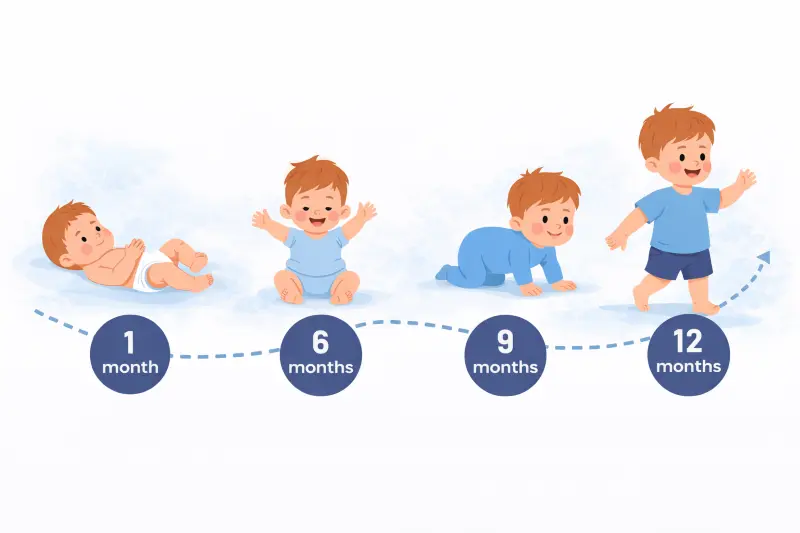
Visual timeline showing baby development stages from lying down to walking, corresponding with growth spurt periods.
The Newborn Phase (0–4 Weeks)
- Timing: Typically occurs between days 7–10 and again at 2–3 weeks.
- Primary Goal: Regaining birth weight. Most newborns lose 7–10% of their body weight in the first few days.
- Signs: Intense cluster feeding (eating every 30–60 minutes) and sleeping for long stretches between feeds.
The 6-Week Peak (6–8 Weeks)
- Timing: Occurs between week 6 and week 8.
- Characteristics: This is statistically associated with peak fussiness and crying duration (often called "PURPLE crying").
- Physiology: The digestive system matures, often causing gas or straining (dyschezia).
- Sleep Impact: Sleep patterns often become erratic; the "newborn sleepiness" wears off.
The 3-Month Shift (12 Weeks)
- Timing: Around 12 weeks of age.
- Development: Growth slows slightly compared to the newborn phase, but head circumference expands as the brain grows.
- Signs: Reduced napping consistency. Infants become more social and distractible during feeds.
The Mid-Year Surge (4–6 Months)
- Timing: A major spurt occurs at 4 months and another at 6 months.
- Weight Gain: By month 5 or 6, many infants double their birth weight.
- Mobility Connection: This physical growth often precedes rolling over or sitting up.
- Sleep Regression: The 4-month mark is famous for sleep cycles maturing, which looks like a regression but is a permanent neurological change.
The Late Infancy Spurt (9 Months)
- Timing: Between 9 and 10 months.
- Physical Changes: Vertical growth (length) often accelerates as the child prepares for standing or cruising.
- Caloric Needs: Interest in solid foods typically increases alongside milk intake.
Toddler Growth Patterns (12–24 Months)
- Timing: 12 months (1 year), 18 months, and 24 months (2 years).
- Velocity: Growth velocity slows significantly. Toddlers gain approximately 5 pounds and grow 4–5 inches between ages 1 and 2.
- Proprioception: Parents of toddlers report "clumsiness" during spurts (e.g., bumping into things) as the child adjusts to longer limbs. Curious about their future height? Use our Height Predictor.

Growth spurts can be exhausting for parents, especially during frequent feeding periods.
Reference Table: Common Growth Spurt Ages
The following table outlines the standard intervals where rapid growth is statistically most likely to occur.
| Age / Stage | Duration | Primary Sign | Associated Milestone |
|---|---|---|---|
| 7–10 Days | 1–2 Days | Constant Hunger | Regaining Birth Weight |
| 2–3 Weeks | 2–3 Days | Cluster Feeding | Alertness Increase |
| 6–8 Weeks | 3–7 Days | Peak Fussiness | Social Smiling / Gas |
| 3 Months | 3–5 Days | Distracted Feeding | Head Control |
| 4 Months | 5–7 Days | Night Waking | Rolling Over |
| 6 Months | 5–7 Days | Solid Food Interest | Doubling Birth Weight |
| 9 Months | 1 Week | Appetite Surge | Crawling / Standing |
| 12+ Months | 1+ Weeks | Increased Sleep | Walking / Cruising |
Growth Spurt vs. Teething vs. Sick: How to Tell
Growth spurts share symptoms with teething and illness. The table below differentiates the signals.
| Symptom | Growth Spurt | Teething | Illness |
|---|---|---|---|
| Fever | No | Low grade (rarely) | Yes (>100.4°F) |
| Appetite | Increases | Decreases (gum pain) | Decreases |
| Sleep | Disrupted or Increased | Disrupted | Increased (Lethargy) |
| Mood | Fussy but consolable | Irritable | Lethargic / Inconsolable |
Parent Survival Guide: How to Cope
Understanding that your baby is experiencing a growth spurt is only half the battle. The other half is surviving it. Here are evidence-based strategies to help you and your baby through these intense periods.
Managing Cluster Feeding
The Reality: Your baby may want to eat every 45 minutes.
The Solution: Do not restrict feeds. This "on-demand" feeding is biologically necessary to signal the mother's body to increase milk supply (for breastfed babies) or to provide fuel for bone growth. Get comfortable, hydrate, and accept that for 2-3 days, you will be feeding constantly. The American Academy of Pediatrics confirms this is normal behavior during growth spurts.
Soothing the "Growing Pains"
The Reality: Rapid bone growth and skin stretching can cause physical discomfort.
The Solution:
- Warm Baths: Helps relax muscles and distract from fussiness.
- Babywearing: The pressure and closeness regulate the infant's heart rate and reduce crying (especially during the 6-week peak).
- Leg Massages: Gentle bicycle legs can help if the spurt is affecting digestion (gas).
The "Size Up" Signal (Diapers & Clothes)
The Sign: Sudden diaper blowouts or red marks on thighs.
The Fix: Growth spurts often result in a sudden need for larger diapers or clothing overnight. If your baby is fussy and nothing works, check if their diaper is too tight.

With proper understanding and coping strategies, growth spurts become manageable phases that lead to peaceful, well-fed babies.
Frequently Asked Questions
How do you know if your baby is going through a growth spurt?
Look for the "Cluster Feeding" signal. The most consistent biological indicator is a sudden, intense demand for milk. Breastfed babies may want to nurse every hour, and bottle-fed babies may finish their bottle and look for more. This is accompanied by increased sleep duration (physiologically required for tissue growth) and general fussiness.
What is the 3-6-9 rule for babies?
A mnemonic device for predicting growth spurts. Parents often use the pattern "3-6-9" to remember the timing of spurts:
- Days: 3 days, 6 days, 9 days (Early newborn adjustments).
- Weeks: 3 weeks, 6 weeks, 9 weeks (Infant spurts).
- Months: 3 months, 6 months, 9 months (Older infant spurts).
While not biologically precise for every child, it tracks closely with the WHO growth velocity data.
Do babies sleep more during growth spurts?
Yes, the body requires sleep to secrete growth hormones. Human Growth Hormone (HGH) is primarily secreted during deep sleep (Slow Wave Sleep). Clinical data suggests that infants may sleep more hours total during a spurt, though the sleep may be broken by hunger (waking to feed).
Do growth spurts ever happen early or late?
Yes, timelines vary by gestational age. A baby born at 38 weeks may hit the "6-week growth spurt" differently than a baby born at 41 weeks. Real-world reports indicate that some infants exhibit symptoms a week prior to the standard timeline, while others lag behind. The timeline is a statistical average, not a schedule.
What is the hardest week with a newborn?
Weeks 6 to 8 are statistically cited as the peak of fussiness. This period aligns with a major growth spurt and the peak of the "crying curve." Infants are more awake than the newborn phase but often lack the ability to self-soothe or regulate digestion effectively, leading to increased parental stress.
How long do growth spurts last?
Typically 2 to 7 days. Newborn spurts (under 6 weeks) are short, often lasting 24–48 hours. As the child ages (4 months and older), the spurts may last up to a week. If fussiness or feeding issues persist longer than a week, pediatricians generally recommend checking for other causes like ear infections or reflux.
Track Your Baby's Progress
Growth spurts are temporary phases, but tracking your baby's overall growth pattern helps ensure they're developing healthily. Use our specialized calculators to monitor their progress and compare against WHO standards.
Height & Weight Percentiles
Check if your baby is following their curve with our WHO Percentile Calculator. Track length, weight, and head circumference against international standards.
Future Height Prediction
Curious about their adult height potential? Our Mid-Parental Height Calculator uses genetic factors to estimate final height.