Quick Summary: Boy Height Standards
The Centers for Disease Control and Prevention (CDC) establishes the reference standards for boy height in the United States. Before comparing numbers, make sure you measure height accurately at home.
- The Baseline: Data comes from the National Health and Nutrition Examination Survey (NHANES) and is published in the official CDC Clinical Growth Charts.
- The "Average": Defined as the 50th percentile. This means exactly 50% of boys are taller and 50% are shorter at that specific age.
- The Reality: Growth is rarely a straight line. The most chaotic changes happen during the "puberty window" between ages 12 and 15.

Regular height tracking helps parents monitor their son's growth against CDC averages and identify potential concerns early.
Table of Contents
Average Height for Boys: Toddlers to Pre-Teens (2–12 Years)
The "Steady Growth" Phase
Between ages 2 and 12, growth is usually predictable. Unlike the rapid growth spurts seen in infancy, this period shows steady, consistent development.
- Velocity: Boys typically gain 2 to 2.5 inches per year.
- Predictability: A boy in the 50th percentile at age 4 is statistically likely to be near the 50th percentile at age 10, barring health issues.
Boys Average Height (Ages 2–12)
| Age (Years) | 50th Percentile (Feet & Inches) | 50th Percentile (Centimeters) | Normal Range (5th–95th) |
|---|---|---|---|
| 2 | 2' 10" | 86.4 cm | 2' 8" – 3' 1" |
| 3 | 3' 1" | 95.3 cm | 2' 11" – 3' 4" |
| 4 | 3' 4" | 101.6 cm | 3' 2" – 3' 7" |
| 5 | 3' 7" | 109.2 cm | 3' 4" – 3' 10" |
| 6 | 3' 9" | 115.5 cm | 3' 7" – 4' 1" |
| 7 | 4' 0" | 121.9 cm | 3' 9" – 4' 3" |
| 8 | 4' 2" | 128.0 cm | 3' 11" – 4' 6" |
| 9 | 4' 5" | 133.3 cm | 4' 1" – 4' 8" |
| 10 | 4' 6" | 138.4 cm | 4' 3" – 4' 11" |
| 11 | 4' 9" | 143.5 cm | 4' 4" – 5' 1" |
| 12 | 4' 10.5" | 149.1 cm | 4' 6" – 5' 4" |
CDC Growth Charts for Boys (2–20 Years)
The official CDC growth charts provide visual representation of height and weight percentiles for boys. These charts are used by pediatricians to track growth patterns and identify potential concerns. It is important to understand the difference between CDC vs. WHO standards when tracking growth.
5th and 95th Percentiles
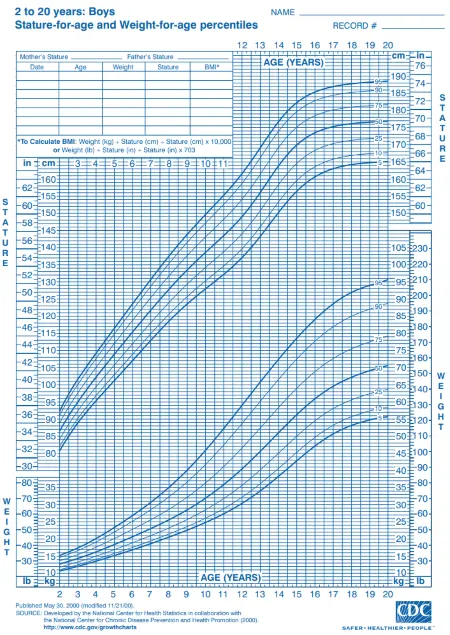
Boys (2 to 20 years)
Stature-for-age and Weight-for-age percentiles (5th and 95th percentiles)
Download PDF Chart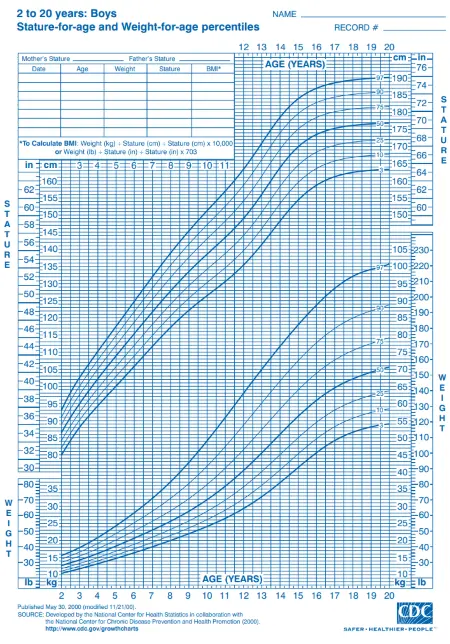
Boys (2 to 20 years)
Stature-for-age and Weight-for-age percentiles (3rd and 97th percentiles)
Download PDF ChartAverage Height for Teen Boys (13–20 Years)
The "Chaos" Phase (Puberty)
Data shows that the most significant height variability occurs during teenage years due to differing puberty start times. You can check exactly where your son falls on the chart using our CDC Percentile Calculator.
- The Discrepancy: At age 13, one boy might be 4'10" (pre-puberty) while his classmate is 5'8" (mid-puberty). Both are medically healthy.
- Peak Velocity: Most boys reach their "Peak Height Velocity" (PHV)—the fastest period of growth—around age 13.5 to 14.
- The Plateau: Growth slows dramatically after age 16 as growth plates begin to fuse.
Want to predict your son's adult height?
Our height calculator uses the Khamis-Roche method to predict adult height based on current measurements and parental genetics.
Calculate Future Height
Teenage boys show dramatic height variations during puberty, with some experiencing growth spurts earlier than others.
Boys Average Height (Ages 13–20)
| Age (Years) | 50th Percentile (Feet & Inches) | 50th Percentile (Centimeters) | Normal Range (5th–95th) |
|---|---|---|---|
| 13 | 5' 1" | 156.2 cm | 4' 8" – 5' 7" |
| 14 | 5' 4.5" | 163.8 cm | 4' 11" – 5' 10" |
| 15 | 5' 7" | 170.1 cm | 5' 2" – 6' 0" |
| 16 | 5' 8" | 173.4 cm | 5' 4" – 6' 1" |
| 17 | 5' 9" | 175.2 cm | 5' 5" – 6' 2" |
| 18 | 5' 9.5" | 176.1 cm | 5' 5" – 6' 2" |
| 19 | 5' 9.5" | 176.5 cm | 5' 5" – 6' 2" |
| 20 | 5' 9.5" | 176.8 cm | 5' 5" – 6' 3" |
Am I Done Growing? (Signs Growth is Stopping)
Shoe Size Plateau
Hands and feet are often the first body parts to stop growing.
The Sign: If a teen boy's shoe size has not increased for 12 months.
The Meaning: It is a physiological indicator that the peak growth spurt is ending, though slight vertical growth may continue for another year.
Shaving Frequency
Facial hair development usually accelerates toward the end of puberty.
The Sign: A full beard and daily shaving requirement.
The Meaning: This correlates with Tanner Stage 5, often indicating that growth plates are fusing.
The "Tanner Stages" of Puberty
Pediatric endocrinologists use Tanner Stages to assess development.
- Stage 3: Peak height growth occurs here.
- Stage 4: Growth slows down significantly.
- Stage 5: Growth plates fuse; adult height is typically reached.
Real-World Scenarios (Case Studies)
Case A: The "Late Bloomer"
- Subject: 14-year-old male.
- Height: 5'0" (Below average).
- Signs: No facial hair, voice has not cracked.
- Analysis: Likely "Constitutional Delay of Growth." His bone age is younger than his chronological age.
- Outcome: He will likely continue growing until age 19 or 20, eventually catching up to his genetic potential.
Case B: The "Early Spiker"
- Subject: 12-year-old male.
- Height: 5'6" (Tall for age).
- Signs: Full puberty signs present at age 11.
- Analysis: He hit his peak growth velocity early.
- Outcome: His growth plates may fuse as early as age 15. He may finish around 5'9" or 5'10" as an adult, despite being the tallest in 6th grade.
Global Height Variations (Ethnicity Matters)
The tables above are based on U.S. CDC data. Genetics and geography play a massive role in "average" height.
Northern Europe (e.g., Netherlands): Average male height is ~6'0" (183 cm). A 5'9" male here is considered short.
South/Southeast Asia (e.g., India/Indonesia): Average male height is ~5'5" to 5'8" (165–172 cm). A 5'9" male here is considered tall.
United States: Overall average is 5'9" (175 cm), but this varies widely across different demographics.
Factors You Can Control (How to Maximize Height)
While genetics determine ~80% of height, lifestyle factors determine if you reach that potential.
Sleep (The HGH Factory)
Human Growth Hormone (HGH) is released in pulses primarily during deep sleep phases.
Requirement: Teens need 8–10 hours.
Impact: Sleeping only 5–6 hours can suppress HGH release, potentially preventing a boy from reaching maximum genetic height.
Nutrition (The Building Blocks)
Posture (The Hidden Inch)
The Issue: "Tech neck" and slouching compress the spine.
The Fix: Strengthening core and back muscles can improve visible height by 0.5 to 1.5 inches by aligning the vertebrae.

Proper nutrition during teenage years is crucial for reaching maximum genetic height potential.
Frequently Asked Questions
Is 5'7" short for a boy?
No, it is within the standard range. The average American male is 5'9". A height of 5'7" falls roughly in the 25th to 30th percentile. This means you are taller than ~30% of adult men. In many parts of the world, 5'7" is the exact average.
Can I still grow after 18?
It is possible but rare. Most boys close their growth plates between ages 16 and 18. However, "Late Bloomers" who started puberty at 15 or 16 may continue growing until age 20. An X-ray of the wrist (bone age study) is the only way to confirm.
What is the average height for a 14-year-old boy?
5 feet 4.5 inches. This is the median (50th percentile). Because age 14 is the peak of puberty, the "normal" range is massive—from 4'11" to 5'10". Being at either end of this spectrum is usually biologically normal.
Does lifting weights stunt growth?
No. This is a long-standing myth. Medical research confirms that properly supervised strength training does not damage growth plates. In fact, resistance training increases bone density, which supports healthy growth.
How tall will I be? (Prediction Formula)
Use the Mid-Parental Formula.
- Add Mother's Height + Father's Height (in inches).
- Add 5 inches to that total.
- Divide by 2.
- Example: Mom (64") + Dad (70") + 5 = 139 / 2 = 69.5 inches (5'9.5").
The most accurate way to estimate this is by using the Mid-Parental Height Formula.