Child Height Calculator
Predict your child's adult height using the Khamis-Roche method, the medical gold standard for growth prediction. Enter current age, height, and parental genetics for a scientifically accurate estimation.
Fill in the information on the left and click calculate to see your height prediction.
What is the Child Height Calculator?
The Child Height Calculator estimates a child's future adult stature using the Khamis-Roche method, a medically validated algorithm that combines current height, weight, and mid-parental genetics. This tool provides a statistical prediction range and percentile ranking based on CDC Growth Standards, offering a reliable baseline for monitoring development without bone-age X-rays.
How to Use the Child Height Calculator
This tool uses the Khamis-Roche method, which requires current measurements of the child and the height of both biological parents to predict future adult stature. Follow these steps to ensure the most accurate result.
Step-by-Step Instructions
1. Select Your Units
Use the toggle switch at the top to choose between Metric (cm/kg) or Imperial (in/lbs). This updates all input fields to match your preferred measurement system.
2. Enter Child's Details
- Gender: Select Male or Female.
- Age: Enter the child's current age in years.
- Current Height: Input the child's standing height (without shoes).
- Current Weight: Input the child's weight. This variable is crucial for the Khamis-Roche formula, as it adjusts the prediction based on skeletal mass.
3. Enter Parental Heights
- Mother's Height: Enter the biological mother's standing height.
- Father's Height: Enter the biological father's standing height.
4. Calculate
Click the "Calculate Height" button. The tool will process the data client-side and display the estimated adult height immediately.
Understanding the Results
The results card provides three specific data points:
- Predicted Height: The most statistically probable adult height (e.g., 5ft 10in).
- Prediction Range: A margin of error (e.g., ± 2 inches) representing the standard deviation. This indicates that 95% of children with similar data will fall within this range.
- Percentile: Where the child's future height ranks compared to the general adult population (e.g., 75th Percentile).
Common Input Errors to Avoid
Accurate data entry is required for a reliable prediction.
- Mixing Units: Ensure you do not enter centimeters while the "Imperial" tab is active.
- Biological Parents Only: The Khamis-Roche method relies on genetic inheritance. Using the height of step-parents or adoptive parents will result in an invalid prediction.
- Estimating Current Height: Guessing the child's current height can skew the final result significantly. It is recommended to measure the child against a flat wall before using the tool.
How This Height Calculator Works
You might be wondering: "How can a website predict my child's future height?"
Unlike basic calculators that simply double a child's height at age two, this tool utilizes the Khamis-Roche Method, which is widely regarded by pediatricians and endocrinologists as the "gold standard" for non-invasive height prediction. Published in the journal Pediatrics in 1994, this method allows us to predict adult stature without the need for expensive or radioactive bone age X-rays.
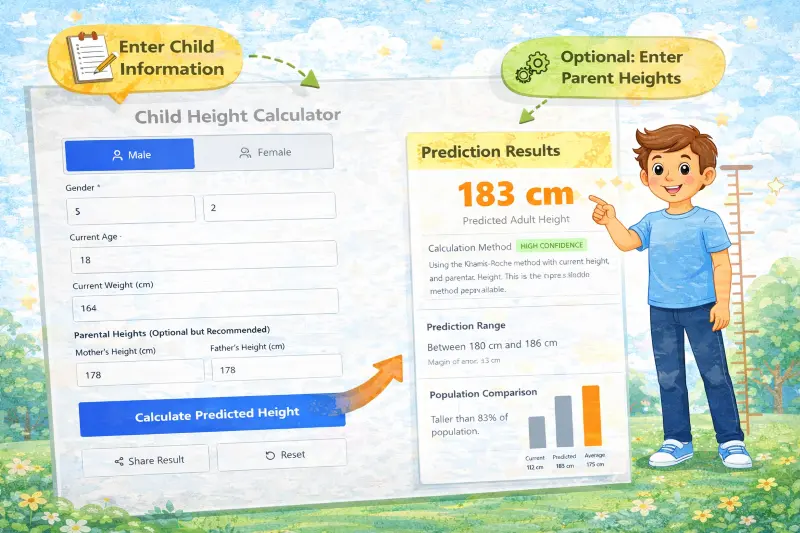
Step-by-step tutorial: How to use our child height prediction calculator interface to get accurate results for your child's future height.
The Formula: How We Calculate Your Result
Our future height calculator processes four specific data points to generate its prediction. By combining current growth metrics with genetic potential, we can achieve an accuracy rate within 1.5 inches for 90% of children between ages 4 and 17.
The calculation logic relies on a weighted regression equation:
Predicted Height = Intercept + (B₁ × Current Height) + (B₂ × Current Weight) + (B₃ × Mid-Parental Height)
Where:
- B₁, B₂, B₃: These are specific coefficients (multipliers) that change based on the child's exact age and gender.
- Intercept: A baseline constant derived from longitudinal growth studies (like the Fels Longitudinal Study).
In simple terms: We take their current size, weigh it against how tall you are, and adjust for how close they are to puberty.
Why We Ask for Parental Height (Mid-Parental Method)
Genetics play the single largest role in determining final adult height accounting for approximately 60% to 80% of the variance. This is why our mid parental height calculator logic is integrated directly into the tool.
We calculate the "Mid-Parental Height" (MPH) using the Tanner Method to establish a genetic baseline:
For Boys
For Girls
Note: If you do not enter parental heights, the calculator switches to a standard percentile projection based on CDC growth charts, though this is statistically less accurate.
Why Weight Matters in Height Prediction
Many users ask why a height calculator needs to know a child's weight. The answer lies in skeletal maturity.
Studies show that children with a higher body mass index (BMI) tend to mature faster biologically.
- Advanced Bone Age: Heavier children often have "older" bones, meaning they may hit their growth spurt earlier but also stop growing sooner.
- Delayed Bone Age: Lighter children may grow for a longer period.
By factoring in weight, the Khamis-Roche method adjusts the prediction to account for this biological tempo, making it significantly more accurate than a simple height predictor calculator.
Understanding Your Child's Height Percentile
When you use our height percentile calculator, you will see a result such as "55th Percentile" or "90th Percentile." But what does this actually mean for your child's growth?
A percentile compares your child to other children of the same age and gender.
- 50th Percentile: This is the exact middle. If your child is in the 50th percentile, they are at the perfect average height.
- 75th Percentile: Your child is taller than 75% of children their age.
- 25th Percentile: Your child is shorter than 75% of children their age.
Pediatricians use a height chart (often from the CDC or WHO) to track this curve over time. Consistency is key. If a child stays steadily in the 40th percentile from age 5 to age 15, they are growing normally. A sudden drop (e.g., falling from the 60th to the 20th percentile) is often a sign to consult a doctor.
Growth Spurts and Puberty
Growth is rarely a straight line. Most children experience a major growth spurt during puberty:
- Girls typically start their growth spurt much earlier than boys, usually between ages 10 and 12 (often around menarche).
- Boys: typically start later, between ages 12 and 14, but grow faster and for longer.
This timing difference explains why girls are often taller than boys in middle school, only to be overtaken by high school.
Average Adult Height: What is "Normal"?
Many parents want to know if their child will reach the average height for a man or woman. These averages vary significantly by country, nutrition, and genetics.

Global height comparison: Average adult heights for men and women across different countries, showing genetic and nutritional variations.
Average Height for Men
In the United States, the average male height is approximately 5 feet 9 inches (175 cm).
Global Context: In the Netherlands, the average is closer to 6 feet (183 cm), while in parts of Asia and Latin America, it may be closer to 5 feet 7 inches (170 cm).
What is considered tall? Generally, a man over 5'11 inches (71 inches) or 180 cm is considered tall in most populations.
Average Height for Women
The average height for girls and women in the US varies by age, but settles at approximately 5 feet 4 inches (162-163 cm).
Unit Conversions:
- 163 cm to feet is approximately 5 feet 4 inches.
- 5'4 in inches is 64 inches.
What is considered tall? A woman over 5 feet 7 inches (170 cm) is generally considered tall.
Height Comparison Chart (Reference)
Use this quick reference to understand common height milestones.
| Height (Feet & Inches) | Height (cm) | Description |
|---|---|---|
| 4'11" | 150 cm | Short Stature (Adult) |
| 5'2" | 157 cm | 5'2 in inches = 62" |
| 5'4" | 163 cm | Average women height (US) |
| 5'9" | 175 cm | Average height of a man (US) |
| 5'10" | 178 cm | 178 cm to feet = 5'10" |
| 6'0" | 183 cm | Tall Stature |
| 6'1" | 185 cm | 185 cm in feet = 6'1" |
Can You Predict Height Accuracy? (The Limitations)

Proper height measurement technique: A mother measuring her child's height against a wall using correct posture and positioning.
While our child height predictor calculator uses advanced medical algorithms, no tool can predict the future with 100% certainty.
- Genetics vs. Environment: While genetics account for 70-80% of height, environmental factors like nutrition, sleep, and health play a massive role.
- The "Extrapolate" Factor: Calculators extrapolate the current growth curve into adulthood. If a child has a delayed puberty (late bloomer), they might currently appear short but end up tall.
- Medical Conditions: Issues like hormonal imbalances can alter the predicted path.
We recommend using this tool as a guideline. For a precise medical assessment, a doctor may determine "Bone Age" by taking an X-ray of the left hand and wrist to see if the growth plates are still open.
The Hormonal Symphony of Growth
Growth is not just about bones stretching; it is a complex biological process orchestrated by your child's endocrine system. Three major players conduct this "symphony," and understanding them helps explain why sleep and diet are so critical.
1. Human Growth Hormone (HGH)
Produced by the pituitary gland, HGH is the primary driver of height. It works by stimulating the liver to produce IGF-1 (Insulin-like Growth Factor 1), which causes the cartilage cells at the ends of long bones to multiply.
The Sleep Connection: HGH is released in "pulses" throughout the day, but the largest and most significant surges occur during deep slow-wave sleep. This is why chronic sleep deprivation can physically stunt a child's growth.
2. Thyroid Hormones (T3 & T4)
Thyroid hormones act as the body's "thermostat" for metabolism, but they are also essential for skeletal development.
Bone Maturation: Without adequate thyroid hormones, the growth plates cannot mature properly, leading to arrested growth. This is why pediatricians often check thyroid function (TSH levels) if a child falls behind on the growth chart.
3. Sex Hormones (Puberty & Growth Plates)
Testosterone and Estrogen trigger the massive growth spurts seen during adolescence, but they also signal the end of growth.
Testosterone: Drives the intense growth spurt in boys and increases bone density.
Estrogen: Drives the growth spurt in girls. However, Estrogen is also responsible for epiphyseal fusion (the closing of the growth plates). Because girls experience a surge of estrogen earlier in puberty than boys, their growth plates fuse sooner, which is why women are generally shorter than men on average.
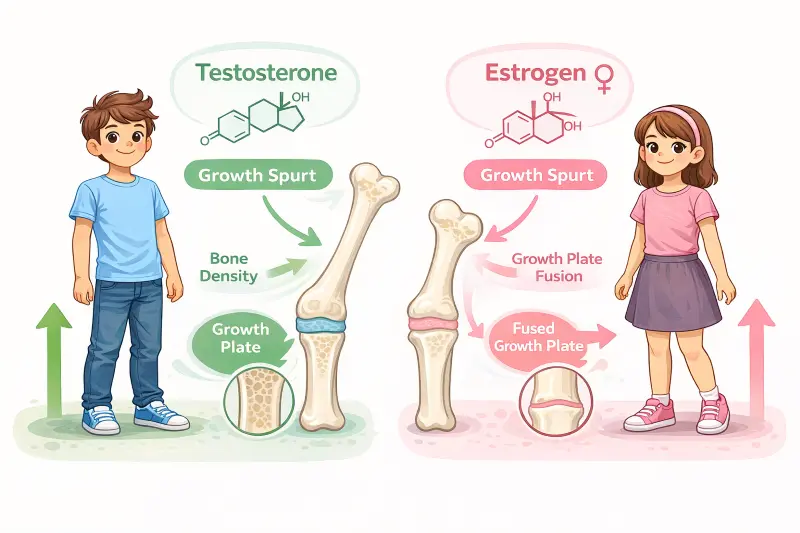
How sex hormones (testosterone and estrogen) drive growth spurts during puberty while simultaneously signaling growth plate closure.
How to Grow Taller: Maximizing Your Genetic Potential
While our child height predictor calculator estimates a future result based on genetics, the final outcome isn't 100% set in stone. Genetics determine the "ceiling" of potential height, but environmental factors determine if a child actually reaches that ceiling.
Parents often ask: "Is there anything we can do to increase this number?" While you cannot change your DNA, you can optimize the three pillars of growth: Nutrition, Sleep, and Posture.

Key factors for maximizing genetic height potential: Proper nutrition, adequate sleep, and healthy lifestyle choices during growth years.
1. The "Growth Diet": Nutrition for Height
Malnutrition is the number one reason children fail to reach their predicted height. To support the rapid bone lengthening that happens during a growth spurt, the body requires specific building blocks.
- Protein is King: Amino acids are the primary building blocks of muscle and tissue. High-protein foods (eggs, lean meats, beans, legumes) stimulate the production of Insulin-like Growth Factor-1 (IGF-1), a hormone essential for longitudinal bone growth.
- Calcium & Vitamin D: Bones need calcium to harden and lengthen. However, calcium cannot be absorbed without adequate Vitamin D. Recommendation: Fortified milk, leafy greens, and safe sun exposure.
- Zinc & Magnesium: Studies suggest that zinc deficiency can lead to stunted growth. Ensuring a diet rich in nuts, seeds, and whole grains can prevent this plateau.
2. Sleep: The Engine of Growth
It is a biological fact: You only grow when you sleep. Human Growth Hormone (HGH) is pulsatile, meaning it is released in bursts. The largest and most significant pulses of HGH occur during slow-wave (deep) sleep.
- Children (Ages 6-13): Need 9-11 hours of sleep.
- Teens (Ages 14-17): Need 8-10 hours.
The Consequence: Chronic sleep deprivation acts like a brake on the height growth calculator prediction, potentially shaving inches off the final adult result.
3. Posture and Spine Health
Sometimes, gaining height isn't about growing bones, but aligning them. Poor posture (slouching) can compress the spine and make a person appear up to 1.5 inches (3-4 cm) shorter than they actually are.
- Core Strength: A strong core supports the spine, keeping it upright against gravity.
- Ergonomics: In an era of screen time, neck posture is critical. Using tools like a standing desk height calculator or ensuring your desk height is ergonomically correct can prevent the "tech neck" curvature that leads to permanent hunching.
- Bike Fit: Even leisure activities matter. Using a bike seat height calculator ensures that when teens exercise, their legs are fully extending without hyperextending, promoting healthy joint alignment.
4. Comparison and Confidence
Finally, it is important to maintain perspective. While we often compare ourselves using a height comparison chart or wonder about the average male height versus our own, health matters more than a specific number.
- The "Height Difference" Myth: Many people worry about the height difference in relationships or sports. In reality, success in sports is rarely determined by height alone.
- Body Proportions: Tools like a waist to height ratio calculator are often better indicators of overall health than height alone.
Frequently Asked Questions
Last Updated: January 1, 2026